





















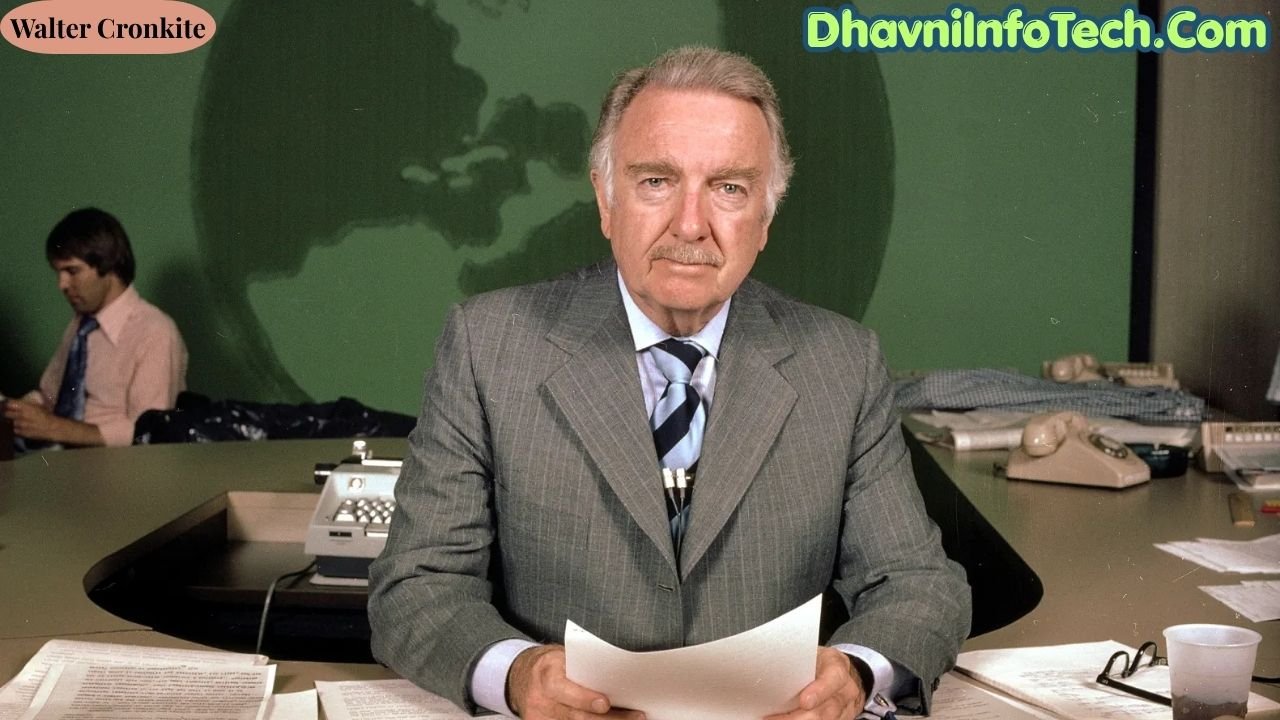
Who Is Walter Cronkite?
For anyone who grew up watching television news in mid-20th-century America, the name Walter Cronkite carries a kind of quiet authority that few broadcasters have ever matched. But for younger readers wondering who is Walter Cronkite — or more precisely, who was Walter Cronkite — the answer is both simple and remarkable.
Walter Cronkite was the anchor of the CBS Evening News for nearly two decades, the man who narrated some of the most pivotal moments in modern history, and a journalist widely regarded as the gold standard of broadcast integrity. He wasn’t just a newsreader. He was, for millions of Americans, the voice of truth itself.
Personal Background: The Man Behind the Microphone
Full Name: Walter Leland Cronkite Jr. Born: November 4, 1916 — Kansas City, Missouri Died: July 17, 2009 — New York City
Walter Cronkite was born in the heart of America, and in many ways, he spent his entire life speaking for it. Raised in Missouri and later Texas, he studied at the University of Texas at Austin but left before graduating — trading the classroom for the newsroom, a decision that would shape American media forever.
His cause of death was cerebrovascular disease, a condition related to the blood vessels supplying the brain. He passed away on July 17, 2009, at the age of 92, leaving behind a nation that genuinely mourned the loss of one of its most familiar and beloved voices.
Walter Cronkite Young: The Making of a Journalist
Long before the television cameras and the network studios, a young Walter Cronkite was cutting his teeth in the rough-and-tumble world of print and radio journalism. In the 1930s, he worked as a newspaper reporter and radio announcer, developing the clear, measured delivery that would later become his trademark.
He joined United Press (UP) as a wire service reporter, learning the discipline of accuracy and speed that print journalism demands. But it was World War II that truly forged Walter Cronkite into the broadcaster history would remember.
During the war, he reported from the front lines in Europe with a fearlessness that earned deep respect from his peers. He flew on actual bombing missions with the U.S. Army Air Forces — not as a passive observer, but as a working journalist committed to telling the real story. After the fighting ended, he covered the Nuremberg Trials from 1945 to 1946, bearing witness to history at one of its darkest and most consequential moments.
Rise in Broadcasting: From Radio Waves to TV Screens
Walter Cronkite joined CBS News in 1950, stepping into a medium — television — that was still finding its footing. He hosted early CBS news programs and documentary series, building an audience that came to recognize his calm, authoritative presence as something they could rely on.
In 1962, he became anchor of the CBS Evening News, a role that would define both him and the profession. The very next year, in 1963, he helped push the broadcast from 15 minutes to a full 30 minutes — a landmark expansion that reflected television’s growing role as America’s primary source of news. It was a subtle but transformative shift, and Walter Cronkite was right at the center of it.
Defining Moments: When the World Watched Walter
The JFK Assassination (1963)
No moment in Walter Cronkite’s career is more iconic than his on-air announcement of President John F. Kennedy’s assassination on November 22, 1963. Removing his glasses, pausing to collect himself, he delivered the news that stopped a nation — and for a brief, heartbreaking moment, even the unshakeable Walter Cronkite was visibly moved. It remains one of the most watched and replayed clips in television history.
The Space Program
Walter Cronkite was a genuine space enthusiast, and it showed. He covered the Mercury, Gemini, and Apollo missions with infectious excitement, making complex science feel accessible and thrilling to everyday viewers. His coverage of the Moon Landing in 1969 was particularly memorable — a jubilant, almost child-like joy breaking through the professional composure as astronauts set foot on the lunar surface.
Walter Cronkite and the Vietnam War
Perhaps no single broadcast moment in American history had more political consequence than Walter Cronkite’s editorial on the Vietnam War in February 1968. After returning from a reporting trip to Vietnam following the Tet Offensive, he looked directly into the camera and told his audience that the United States appeared to be “mired in stalemate.”
It was a stunning departure from journalistic neutrality — and it landed like a thunderclap. President Lyndon B. Johnson reportedly said that if he had lost Walter Cronkite, he had lost Middle America. Whether or not those exact words were spoken, the sentiment captures the truth: Walter Cronkite’s Vietnam War commentary helped shift the entire arc of American public opinion on one of the most divisive conflicts in the nation’s history.
The Watergate Scandal
When the Watergate scandal erupted in the early 1970s, Walter Cronkite again rose to the occasion. CBS News devoted extensive airtime to explaining the complex story to American viewers, and his measured, thorough coverage helped make sense of a constitutional crisis that might otherwise have seemed too tangled to follow.
The Iran Hostage Crisis (1979–1981)
During the Iran Hostage Crisis, Walter Cronkite made an editorial decision that became a powerful form of journalism in itself — ending each CBS Evening News broadcast with a day count of how long American hostages had been held. Night after night, the number climbed. It was simple, restrained, and deeply effective.
Walter Cronkite’s Signature Sign-Off
Ask anyone who watched the CBS Evening News during Walter Cronkite’s tenure, and they’ll remember it instantly: “And that’s the way it is.”
The Walter Cronkite sign-off was more than a closing line — it was a promise. It told viewers that what they had just heard was the truth, delivered straight, without embellishment. In an era before social media noise and partisan cable news, that simple phrase carried enormous weight. It was journalism’s handshake with the American public, renewed every evening.
The Most Trusted Man in America: Reputation & Public Trust
In 1972, a polling survey asked Americans which public figures they trusted most. Walter Cronkite came out on top — ahead of politicians, business leaders, and other journalists. The title “The Most Trusted Man in America” was not a marketing slogan. It was a reflection of something real: decades of honest, careful, courageous reporting that had built a relationship of genuine trust with the viewing public.
He represented a golden era of broadcast journalism — one defined by a commitment to facts, fairness, and the belief that the public deserved to be well-informed.
Walter Cronkite’s Wife and Family Life
Walter Cronkite married Mary Elizabeth “Betsy” Maxwell in 1940, and the two remained together until her death in 2005 — a partnership of 65 years. Betsy was his steadying presence throughout his career, and her passing deeply affected him in his final years.
He is survived by children and Walter Cronkite’s grandchildren, who have carried on the family legacy in various professional and personal pursuits. His family has spoken warmly about a man who, despite his enormous public profile, was deeply devoted to those closest to him.
Walter Cronkite’s Net Worth
Walter Cronkite accumulated considerable wealth over his long career. Estimates of Walter Cronkite’s net worth at the time of his death were reported to be in the range of $20 million, a figure reflecting not just his salary at CBS but also his work as an author, speaker, and public figure in retirement. He lived well but was not known for extravagance — his passion was sailing, a hobby he pursued throughout his life.
Retirement and Later Years
Walter Cronkite retired from the CBS Evening News anchor desk on March 6, 1981, a date that felt, for many viewers, like the end of an era. He remained with CBS News as a correspondent and commentator, but the nightly broadcast — that steady ritual of trust — belonged to someone else now.
In retirement, he stayed active. He wrote his memoir, A Reporter’s Life, published in 1996 — a Walter Cronkite book that offered readers an intimate look at his journey from small-town journalism to the center of global history. He continued public speaking, advocating for causes he believed in, and indulging his love of sailing on the open water.
Walter Cronkite Quotes That Still Resonate
A few Walter Cronkite quotes that capture his philosophy:
- “In seeking truth you have to get both sides of a story.”
- “America’s health care system is neither healthy, caring, nor a system.”
- “Whatever the cost of our libraries, the price is cheap compared to that of an ignorant nation.”
- “I think it is absolutely essential in a democracy to have competition in the media, a lot of competition, and we seem to be moving away from that.”
Each of these reflects a man who thought carefully about journalism’s role in a free society — and who never stopped believing that an informed public was the foundation of democracy.
The Walter Cronkite Award and His Honors
The Walter Cronkite Award for Excellence in Journalism is presented by Arizona State University’s Walter Cronkite School of Journalism and Mass Communication. It honors individuals who have demonstrated outstanding achievement in journalism — a fitting tribute to a man who set the standard for the profession.
Walter Cronkite received the Presidential Medal of Freedom in 1981 and was inducted into numerous journalism halls of fame throughout his life. His contributions to the field have been recognized not just with awards, but with the more enduring honor of influencing generations of journalists who followed in his footsteps.
The Walter Cronkite Museum
The Walter Cronkite Museum is located within the Walter Cronkite School of Journalism and Mass Communication at Arizona State University in Phoenix. The museum celebrates his life and career through exhibits, artifacts, and archival materials — offering visitors a window into both the man and the era he defined. It serves as an educational resource for journalism students and a place of reflection for those who remember watching him every evening.
Legacy: Why Walter Cronkite Still Matters
More than a decade after his passing, Walter Cronkite’s legacy endures in ways both tangible and intangible. He helped define what a television news anchor could and should be — not a performer or a pundit, but a trusted public servant of information.
His decision to speak plainly about Vietnam, his emotional humanity during the Kennedy assassination, his childlike wonder during the Moon Landing — these moments weren’t just great television. They were journalism doing exactly what it’s supposed to do: connecting people to the truth of the world around them.
In an age of fragmented media, partisan narratives, and declining public trust in journalism, Walter Cronkite stands as a reminder of what the profession can aspire to. He believed in the power of the press — not as a political weapon, but as a democratic necessity.
The Walter Cronkite Epstein Connection: Setting the Record Straight
Searches linking Walter Cronkite and Epstein appear online from time to time, often tied to social media speculation or conspiracy-adjacent content. It’s worth noting clearly: there is no credible, documented journalistic connection between Walter Cronkite and Jeffrey Epstein. Walter Cronkite died in 2009, and any claims linking him to that scandal should be approached with healthy skepticism and a demand for verified sourcing. His reputation was built on a lifetime of integrity, and unsupported online claims deserve scrutiny — exactly the kind of scrutiny he himself would have applied.
Key Themes in His Life and Work
Walter Cronkite’s career touches on themes that remain urgently relevant today:
- The evolution of TV news during the Cold War era showed how a single trusted voice could shape national understanding
- His Vietnam War reporting demonstrated media’s profound role in shaping public opinion on armed conflict
- His retirement marked the beginning of a slow decline in the “authoritative anchor” model — a shift still felt today
- His career stands as a lasting argument for ethics, objectivity, and courage in broadcast journalism
Final Thoughts
Walter Cronkite was, in the truest sense, the broadcaster America grew up with. He was there for the assassinations, the space races, the wars, and the scandals — always steady, always honest, always finishing with those seven words that felt like a guarantee: “And that’s the way it is.”
He wasn’t perfect, and he’d be the first to say so. But he was trustworthy — and in journalism, that might be the highest compliment of all.
Also Read: Karlie Kloss The Supermodel Who Became a Tech Mogul, Media CEO, and Philanthropist